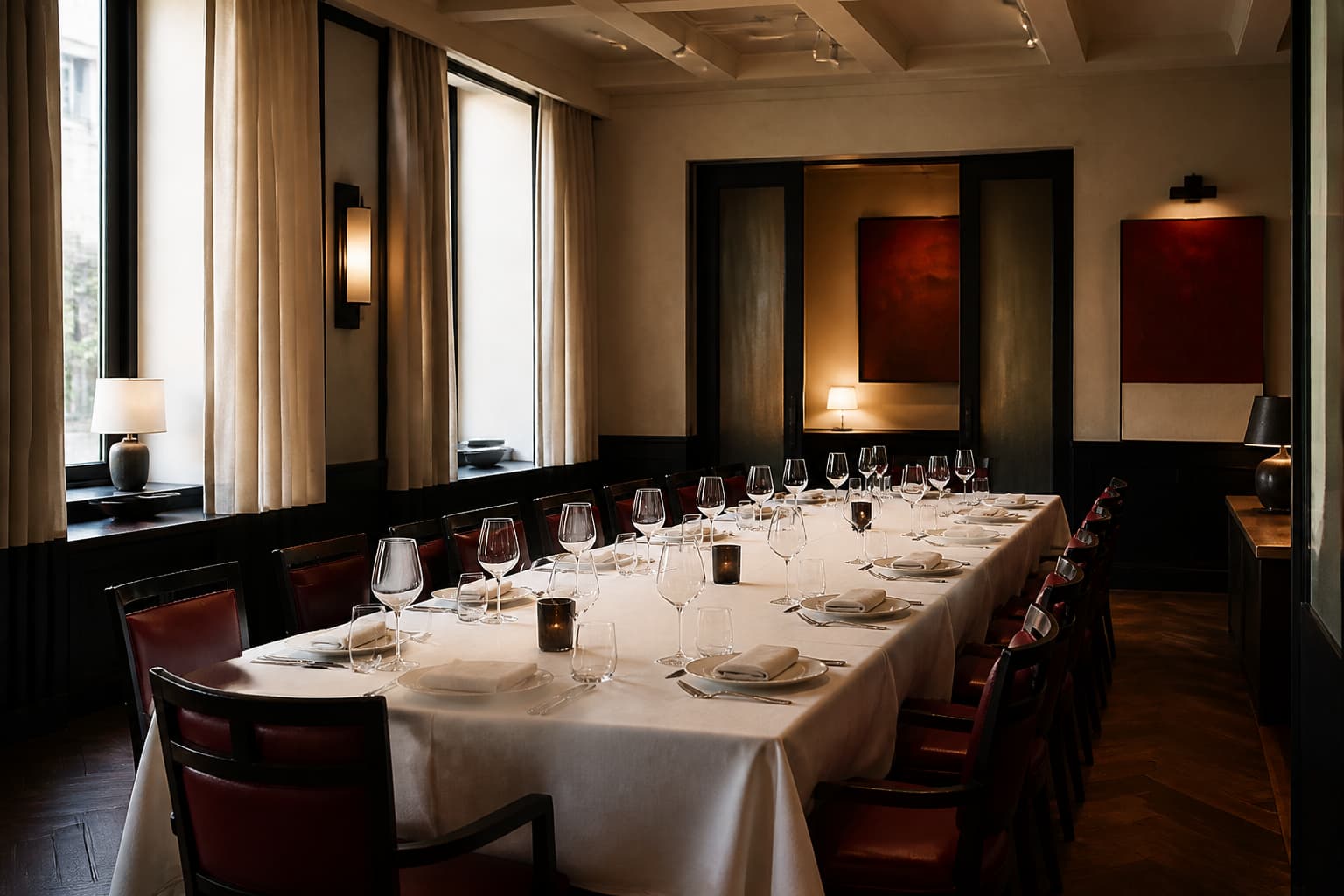
A restaurant buyout price should begin with the revenue the room would normally produce during the requested service—not with a competitor's package or a round number.
OpenTable distinguishes partial buyouts from full buyouts and describes minimum spend as a tool for covering the revenue attached to the space and time being reserved.
A published daytime-buyout contract from Scarlett Begonia shows why the headline minimum is not the whole offer: deposit, cancellation terms, tax and service are stated separately.
The reading
1. Establish the displaced service. Start with the exact room, date and service the client wants. Use the restaurant's own comparable trading history to establish what accepting the buyout removes from ordinary service. A Tuesday lunch, a Saturday dinner and a terrace in peak season are three different products. If reliable history is unavailable, record that uncertainty; do not replace it with an invented benchmark.
2. Define what the client is buying. Write down whether the offer covers one room, one floor or the entire venue; which hours include setup and breakdown; and which spaces remain open to other guests. “Private” is not a usable commercial term until its perimeter is explicit.
3. Separate the minimum from the extras. The minimum spend is the amount applied to eligible food and beverage. Staffing beyond the normal roster, rentals, production, security, tax and service belong on their own lines. This separation lets the client compare offers accurately and lets operations see what must actually be delivered.
4. Price the risk as terms, not padding. A deposit, a payment schedule, a final-guarantee date and a cancellation ladder state who carries the risk at each stage. Hiding that risk inside a larger unexplained minimum makes the offer harder to defend and still leaves the team exposed when the event changes.
5. Give the team an approval rule. The written offer should identify who may discount, what can be exchanged for that discount, and when an exception needs senior approval. The result is not one universal price. It is a repeatable decision: the same inputs produce the same commercial conversation, whoever answers the enquiry.
— Maison Pompon
Sources & image credits
Editorial sources
Image
Maison Pompon editorial studio · original AI-generated image
Original image generated for Maison Pompon